































What You Tolerate Reveals What You Believe You Deserve
Discover how the behavior you tolerate reflects your self-worth, the beliefs you hold about yourself, and practical steps to build healthier boundaries and relationships.
Every "Yes" to Disrespect Is Often a "No" to Yourself
Have you ever stayed silent when someone crossed your boundaries?
Have you excused behavior that hurt you because you didn't want conflict?
Have you accepted less than you truly needed because you were afraid of losing someone?
Perhaps you've found yourself saying:
"Maybe I'm expecting too much."
"At least they're trying."
"Nobody is perfect."
"I don't want to be difficult."
"Things will get better."
So you wait.
You hope.
You make excuses.
You give second chances.
Then third chances.
Then fourth.
Until one day you look at your life and quietly wonder,

"How did I end up accepting so little?"
The painful truth is that most people don't wake up one morning and decide to tolerate disrespect, inconsistency, manipulation, or emotional neglect.
It happens gradually.
One ignored boundary.
One broken promise.
One dismissed feeling.
One apology without change.
One compromise after another.
Eventually, what once felt unacceptable begins to feel normal.
Not because you've become weak.
But because human beings adapt.
The danger is that over time, what you repeatedly tolerate can begin to shape what you believe you deserve.
That's why this article isn't really about other people's behavior.
It's about the beliefs underneath your tolerance.
Because boundaries don't begin with saying "no" to someone else.
They begin with saying "yes" to your own worth.
Tolerance Is More Powerful Than Most People Realize
Many people believe that tolerance is always a virtue.
Sometimes it is.
Patience.
Grace.
Compassion.
Understanding.
These are beautiful qualities.
Healthy relationships require them.
But there is another kind of tolerance that slowly damages your confidence.
The tolerance of repeated disrespect.
The tolerance of dishonesty.
The tolerance of emotional neglect.
The tolerance of constant criticism.
The tolerance of relationships where your needs are always secondary.
The tolerance of environments that repeatedly diminish your peace.
Every time unhealthy behavior becomes normal, something inside you begins receiving a message.
Maybe this is all I deserve.
Most people never say those words out loud.
But they begin living as though they believe them.
What You Accept Becomes Your Standard
Imagine renting an apartment with a small leak in the ceiling.
At first, it bothers you.
You complain.
You notice it every day.
But weeks pass.
Months pass.
Eventually, you stop noticing the drip.
Not because the leak disappeared.
Because you adapted.
Relationships can work the same way.
What shocks you at the beginning can become normal if it continues long enough.
Disrespect becomes "just how they are."
Broken promises become "they're really busy."
Emotional distance becomes "they've always struggled to communicate."
Criticism becomes "they're only trying to help."
Slowly, your expectations begin to shrink.
Instead of asking,
"Is this relationship healthy?"
You begin asking,
"How much more can I tolerate?"
That is one of the most dangerous questions we can ask ourselves.
Because healthy relationships are not built on endurance.
They are built on mutual respect, honesty, care, and emotional safety.
The Real Issue Isn't Always What You Tolerate
It's Why You Tolerate It
This is where many conversations stop.
People tell you:
"Know your worth."
"Set boundaries."
"Leave."
While those suggestions may be well intentioned, they often overlook the deeper question.
Why is it so difficult to leave?
Why do intelligent, kind, capable people remain in situations that consistently hurt them?
The answer often has very little to do with intelligence.
And everything to do with beliefs.
Our actions are usually driven by what we believe to be true.
If you believe:
"I don't deserve better..."
You'll settle.
If you believe:
"I have to earn love..."
You'll overgive.
If you believe:
"Conflict means rejection..."
You'll avoid difficult conversations.
If you believe:
"Being alone is worse than being mistreated..."
You'll stay far longer than your heart can afford.
Changing your life doesn't begin by forcing different behavior.
It begins by examining the beliefs underneath that behavior.
Where Do Those Beliefs Come From?
Many of our deepest beliefs are formed long before adulthood.
As children, we quietly learn lessons about ourselves.
Not through lectures.
But through experiences.
If your feelings were regularly dismissed, you may have learned:
"My emotions don't matter."
If affection felt conditional, you may have learned:
"Love has to be earned."
If peace depended on keeping everyone happy, you may have learned:
"Other people's needs matter more than mine."
If criticism was constant, you may have learned:
"I'll never be good enough."
These beliefs often become invisible.
You don't wake up thinking them.
You simply live from them.
And because they're familiar, they feel true.
The encouraging news is this:
Beliefs can be questioned.
Patterns can be changed.
Healing begins when you become curious about the stories you've been telling yourself not to judge them, but to decide whether they still belong in the life you're trying to build.
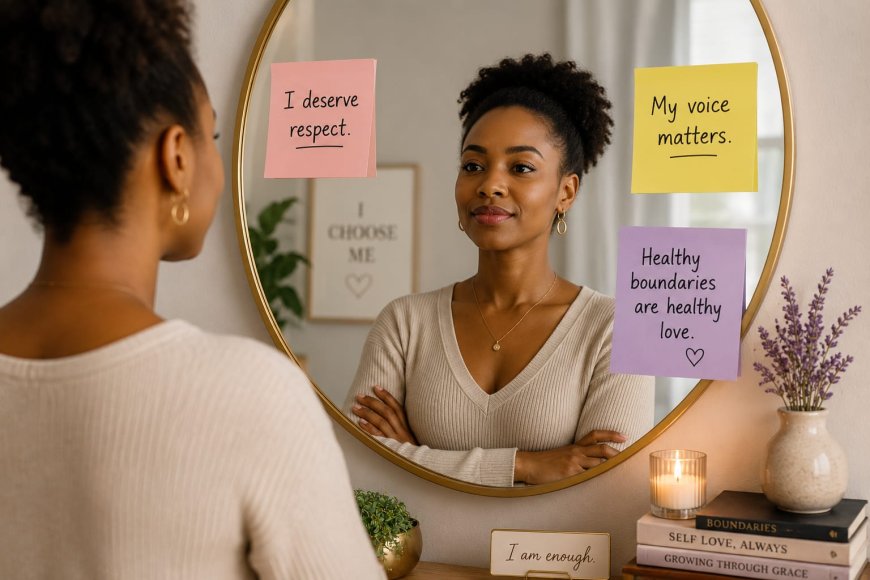
What You Tolerate Is Often a Mirror
A mirror doesn't create reality.
It reflects it.
In the same way, the behavior you consistently tolerate can reveal something about how you currently see yourself.
Not because you deserve poor treatment.
But because your internal beliefs often influence what feels acceptable.
If you believe you are worthy of respect, you'll notice disrespect sooner.
If you believe your voice matters, you'll be more likely to speak up when your needs are ignored.
If you believe your peace is valuable, you'll think carefully before remaining in environments that repeatedly disturb it.
This isn't about blame.
It's about awareness.
Because when you understand the connection between your beliefs and your boundaries, you begin to see that lasting change doesn't start with changing everyone else.
It starts with changing what you believe is acceptable for your own life.
Reflection Quote
"People don't always treat you according to your value—but over time, your boundaries often communicate what you believe your value is."
Before We Go Any Further…
Pause for a moment and ask yourself:
- What have I been excusing for far too long?
- Where in my life have I confused patience with self-abandonment?
- What behavior have I normalized simply because it's familiar?
- If someone I deeply loved were living my life, what advice would I give them?
Don't rush your answers.
Awareness is the beginning of transformation.
And sometimes one honest answer can change the direction of your life.
10 Ways What You Tolerate Reveals What You Believe You Deserve
The things we tolerate are rarely random.
They often reflect the beliefs we've quietly accepted about ourselves, our value, and what we think love, respect, and success should look like.
The good news?
If your tolerance was learned, it can also be unlearned.
Let's explore ten areas where this often shows up.
1. You Tolerate Constant Disrespect
Someone repeatedly speaks to you harshly.
They mock your opinions.
Dismiss your feelings.
Interrupt you.
Belittle your dreams.
Embarrass you in front of others.
At first, it hurts.
But after enough time, you stop reacting.
You tell yourself:
"That's just how they are."
"They don't really mean it."
"I don't want to make a big deal out of it."
But every time disrespect becomes normal, your mind begins receiving a subtle message:
"Maybe I don't deserve to be treated with respect."
Respect isn't something you have to earn after proving your worth.
Healthy relationships begin with mutual respect.
Reflection
Ask yourself:
Have I become so used to disrespect that I've stopped recognizing it?
2. You Tolerate One-Sided Relationships
You're always the one checking in.
Always the one apologizing.
Always the one making plans.
Always the one keeping the relationship alive.
You convince yourself that if you love harder...
Give more...
Wait longer...
Eventually things will balance out.
But healthy relationships aren't built on one person carrying all the emotional weight.
Love requires effort from both people.
Healthy Reminder
Stop asking:
"How can I make them choose me?"
Start asking:
"Is this relationship choosing me too?"
3. You Tolerate Broken Promises
"I'll change."
"I promise next time will be different."
"I'm working on it."
Weeks pass.
Months pass.
Nothing changes.
Words without consistent action slowly teach you to expect disappointment.
One of the healthiest relationship skills you can develop is learning to trust patterns more than promises.
People aren't perfect.
But consistency matters.
Reflection
Have I been believing potential instead of paying attention to patterns?
4. You Tolerate Emotional Neglect
Perhaps they provide financially.
Perhaps they're physically present.
Yet emotionally...
You feel alone.
You hesitate to share your feelings because they rarely respond with curiosity or care.
You begin telling yourself:
"Maybe I'm just too emotional."
No.
Wanting emotional connection doesn't make you needy.
It makes you human.
Emotional neglect often leaves invisible wounds because nothing dramatic appears to happen.
Instead, something important quietly doesn't happen.
You don't feel seen.
Heard.
Known.
Supported.
Healthy love makes room for emotions.
Not because every feeling has to be solved.
But because every person deserves to feel emotionally safe.
Quote
"The absence of emotional connection can be just as painful as obvious conflict."
5. You Tolerate Constant Self-Abandonment
How often do you silence yourself just to keep the peace?
How many dreams have you postponed?
How many opinions have you hidden?
How many boundaries have you ignored because someone else might be disappointed?
Every time you abandon yourself to maintain approval, you quietly teach yourself that your needs matter less.
But healthy relationships don't require you to disappear.
They make room for the real you.
Journal Prompt
Where have I been abandoning myself in order to be accepted?
Reflection Break
Pause for a moment.
Take a slow breath.
Read these questions carefully.
- What behavior have I repeatedly excused?
- What have I been afraid would happen if I spoke up?
- Where have I mistaken tolerance for love?
- If nothing changed over the next five years, would I still choose this situation?
Awareness creates choice.
Choice creates change.
6. You Tolerate Feeling Drained All the Time
Healthy relationships don't leave you emotionally exhausted every day.
Every relationship has challenges.
Every family experiences conflict.
Every friendship has misunderstandings.
But if every interaction leaves you anxious...
Walking on eggshells...
Second-guessing yourself...
Feeling emotionally depleted...
It's worth asking why.
Many people have become so accustomed to emotional survival that peace feels unfamiliar.
Healing often begins when you realize that constant exhaustion isn't proof that you're loving well.
Sometimes it's evidence that you're carrying far more than you were ever meant to.
7. You Tolerate Being the Fixer
Someone is struggling.
Immediately, you step in.
You solve.
Rescue.
Encourage.
Carry.
Sacrifice.
Repeat.
Helping others is beautiful.
But when your identity becomes dependent on fixing everyone else, you may lose yourself in the process.
Many people who constantly rescue others secretly hope that if they're needed enough...
They'll finally feel loved enough.
The problem is that love built on usefulness is fragile.
Healthy relationships are built on mutual care not one person constantly rescuing another.
Reflection
Do I help because I genuinely want to or because I fear people won't value me otherwise?
8. You Tolerate Fear More Than Freedom
Fear whispers:
"What if nobody else comes?"
"What if I end up alone?"
"What if leaving is the wrong decision?"
Fear convinces us to stay where we no longer belong.
Growth often begins with one courageous decision:
Choosing uncertainty over guaranteed unhappiness.
That doesn't mean making impulsive decisions.
It means refusing to let fear become the architect of your future.
Mid-Article Reflection
If this article is challenging you, that's okay.
Growth often feels uncomfortable before it feels freeing.
Remember:
The goal isn't to criticize yourself for what you've tolerated.
The goal is to understand why you've tolerated it so you can begin making different choices.
Healing grows through awareness, not shame.
9. You Tolerate Environments That Constantly Shrink You
Some environments inspire growth.
Others quietly convince you to become smaller.
Perhaps you're constantly criticized.
Ignored.
Undervalued.
Compared.
Controlled.
You stop dreaming.
Stop speaking.
Stop believing in yourself.
Not because you lack potential.
Because you've adapted to an environment that never celebrates it.
Healthy environments don't demand that you become less of yourself.
They create space for you to become more fully yourself.
10. You Tolerate Less Than You're Truly Worth Because You Haven't Yet Fully Believed Your Worth
This is where every previous point comes together.
The issue isn't that you consciously think:
"I deserve poor treatment."
Very few people believe that intentionally.
Instead, many quietly live beneath their value because of beliefs they've carried for years.
Beliefs such as:
- I should be grateful for whatever I receive.
- I don't want to ask for too much.
- Love always hurts.
- My needs aren't important.
- This is probably the best I'll ever find.
- If I leave, nobody else will want me.
These beliefs don't simply influence your relationships.
They influence every decision you make.
But here's the truth.
Your worth has never been determined by how other people treat you.
It has never been determined by rejection.
By abandonment.
By criticism.
By divorce.
By failure.
By heartbreak.
Your worth is inherent.
Healing begins the moment you stop asking,
"How can I convince people to value me?"
And begin asking,
"Why have I forgotten my own value?"
Powerful Quote
"The moment you truly believe you deserve peace, respect, honesty, and kindness, you'll find it much harder to tolerate anything less."
How to Stop Accepting Less Than You Deserve
Recognizing unhealthy patterns is a powerful first step.
But awareness alone doesn't change your life.
Transformation begins when awareness becomes action.
If you've realized that you've been tolerating behavior that diminishes your peace, your confidence, or your self-respect, know this:
You don't have to change everything overnight.
Healing rarely happens through one dramatic decision.
It usually happens through many small, intentional choices repeated consistently.
Every healthy boundary you set.
Every honest conversation you have.
Every time you choose peace over people-pleasing.
Every time you stop making excuses for behavior that consistently hurts you.
Every time you believe your needs matter.
You are strengthening your sense of self-worth.
Little by little.
Day by day.
Five Healthy Shifts That Can Change Your Life
1. Start Listening to Your Discomfort
Many people ignore their intuition because they don't want to appear dramatic.
But discomfort is often information.
When something consistently leaves you feeling anxious, unseen, or emotionally unsafe, don't silence that feeling.
Become curious about it.
Ask yourself:
"What is this situation trying to teach me?"
Sometimes your discomfort isn't asking you to work harder.
Sometimes it's asking you to stop settling.
2. Let People's Actions Speak Louder Than Their Words
Words matter.
Promises matter.
Apologies matter.
But consistent behavior matters even more.
Healthy relationships are built on repeated actions, not repeated promises.
When someone's actions continually contradict their words, believe the pattern—not the potential.
3. Stop Negotiating Your Core Needs
You don't have to apologize for wanting:
- Respect.
- Honesty.
- Emotional safety.
- Healthy communication.
- Consistency.
- Kindness.
Those aren't unrealistic expectations.
They're healthy relationship foundations.
Never convince yourself that asking for basic respect is asking for too much.
4. Build Your Self-Worth From the Inside Out
One of the greatest mistakes we make is waiting for other people to convince us we're valuable.
Real confidence doesn't begin when everyone approves of you.
It begins when you stop needing everyone to.
Your worth isn't determined by:
- How many people choose you.
- Whether someone texts back.
- Your relationship status.
- Your income.
- Your appearance.
- Your past mistakes.
Your worth is something you carry.
Not something other people give you.
5. Practice Boundaries Without Guilt
Many people believe boundaries push people away.
Healthy boundaries don't push away healthy people.
They reveal who is willing to respect you.
Boundaries are not walls.
They are guidelines that protect your emotional well-being.
Every healthy boundary communicates one powerful message:
"I believe my peace matters too."
Reflection Quote
"Self-worth isn't measured by what you're willing to endure. It's reflected in what you're no longer willing to accept."
Green Flags to Welcome Into Your Life
As you strengthen your self-worth, begin looking for qualities that support emotional health.
Choose people who:
✔ Respect your boundaries.
✔ Celebrate your growth.
✔ Speak honestly.
✔ Apologize when they're wrong.
✔ Keep their promises.
✔ Communicate consistently.
✔ Make you feel emotionally safe.
Healthy relationships aren't perfect.
But they are emotionally safe enough for both people to grow.
Journal Prompts
Take some quiet time this week and reflect on these questions.
- What have I been tolerating that no longer aligns with the person I'm becoming?
- What belief has kept me accepting less than I deserve?
- Where do I need healthier boundaries?
- What does self-respect look like in my daily life?
- If I truly believed I was worthy of respect, what would I stop accepting today?
Write honestly.
Not to judge yourself.
But to understand yourself.
Final Reflection
Perhaps the most important lesson from this article is this:
People will not always treat you the way you deserve to be treated.
But over time, your willingness to tolerate unhealthy behavior can quietly teach others what you'll accept.
The good news?
That pattern can change.
Every boundary you set tells a new story.
Every difficult conversation builds courage.
Every decision to walk away from what continually diminishes you creates room for something healthier.
Remember:
You are not difficult because you have standards.
You are not selfish because you protect your peace.
You are not asking for too much because you desire respect, honesty, consistency, and kindness.
Those are not luxuries.
They are the foundations of emotionally healthy relationships.
Your life begins to change the moment you stop asking,
"How much more can I tolerate?"
And begin asking,
"What kind of life am I worthy of creating?"
The answer to that question has the power to transform every relationship you build—including the one you have with yourself.
Frequently Asked Questions
1. What does "what you tolerate reveals what you believe you deserve" mean?
It means that the behavior we repeatedly accept can sometimes reflect our current beliefs about our worth, our boundaries, and what we think is acceptable in our lives. Recognizing these patterns can be the first step toward building healthier relationships and stronger self-respect.
2. Why do people tolerate unhealthy relationships?
People stay for many reasons, including hope that things will improve, fear of being alone, emotional attachment, previous experiences, financial concerns, or beliefs formed earlier in life. Every situation is unique, and understanding your own reasons can help you make more intentional choices.
3. How does self-worth affect boundaries?
When you value yourself, it often becomes easier to communicate your needs, protect your emotional well-being, and recognize when a relationship or situation no longer aligns with your values.
4. Is setting boundaries selfish?
No. Healthy boundaries help create respectful relationships by making expectations clear and protecting your emotional and mental well-being.
5. How do I stop accepting poor treatment?
Start by becoming aware of the patterns you've normalized, identifying the beliefs beneath them, clarifying your values, practicing healthy boundaries, and seeking supportive relationships that encourage mutual respect and growth.
Ready to Stop Settling for Less Than You Deserve?
If this article challenged the way you've been thinking about your relationships, your boundaries, or your self-worth, don't let the insight end here.
Real transformation happens when awareness is followed by intentional action.
Continue Your Journey with Grace N Grit Coaching
At Grace N Grit Coaching, I help individuals, couples, and families heal emotionally, rebuild self-worth, strengthen emotional resilience, and create healthier relationships through practical coaching, guided reflection, and transformational tools.
If you're ready to move from simply surviving to living with greater confidence, clarity, and emotional freedom, I'd be honored to walk alongside you on that journey.
Your past may explain some of your patterns but it does not have to define your future.
Ready to Stop Accepting Less Than You Deserve?
The things you tolerate don't just reveal what's happening around you.
They often reveal the beliefs you've been carrying about yourself for years.
If this article resonated with you, don't stop at awareness.
Take the FREE Identity Reset Assessment to uncover the hidden beliefs shaping your confidence, relationships, boundaries, and self-worth.
As a bonus, you'll also receive my Self-Worth Reset Workbook a practical guide filled with reflection exercises, neuroscience-informed tools, boundary-building strategies, and a 7-day reset plan to help you rebuild your self-worth from the inside out.
Take the FREE Identity Reset Assessment
https://grace-n-grit-coaching-hub.kit.com/f66a81ae02
You don't have to keep settling for less than you deserve. Your healing journey can begin today.
What's Your Reaction?
 Like
0
Like
0
 Dislike
0
Dislike
0
 Love
0
Love
0
 Funny
0
Funny
0
 Angry
0
Angry
0
 Sad
0
Sad
0
 Wow
0
Wow
0